
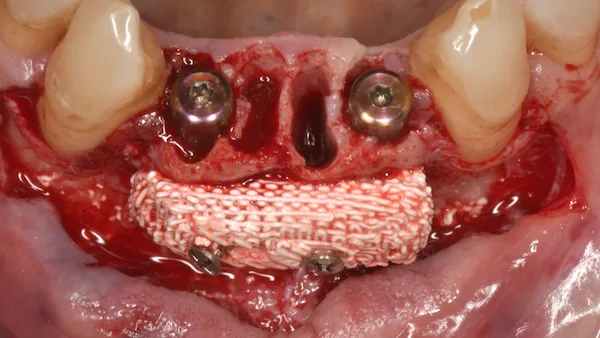

3D printed block for intraoral bone reconstruction
 Surgery
Reconstruction of intraoral bone defects remains a major challenge in implant dentistry, particularly in cases of severe horizontal and vertical atrophy where conventional grafting techniques may be limited by donor site morbidity and anatomical constraints. Recent advances in digital workflows and biomaterials have introduced 3D-printed synthetic bone blocks as a promising alternative to traditional autogenous grafts.
This surgery presents the application of customized 3D-printed synthetic scaffolds for intraoral bone reconstruction. Using cone beam computed tomography (CBCT) data and computer-aided design (CAD), patient-specific bone defects are digitally reconstructed, allowing precise fabrication of synthetic blocks that match the defect morphology. These scaffolds are designed with controlled porosity to enhance vascularization, cell migration, and new bone formation.
The customized fit of the 3D-printed block improves primary stability and reduces intraoperative adjustments, thereby shortening surgical time and increasing procedural predictability. Additionally, the elimination of a donor site significantly decreases patient morbidity and postoperative discomfort. When combined with appropriate fixation and barrier membranes, these synthetic constructs can support guided bone regeneration and facilitate subsequent or , as presented in this clinical case, an immediate implant placement.
This content is reserved for OREC Prime members.
Already have an OREC Prime account?
Not in OREC Prime Community yet?
Join a growing network of professionals and get free access to exclusive resources.
