
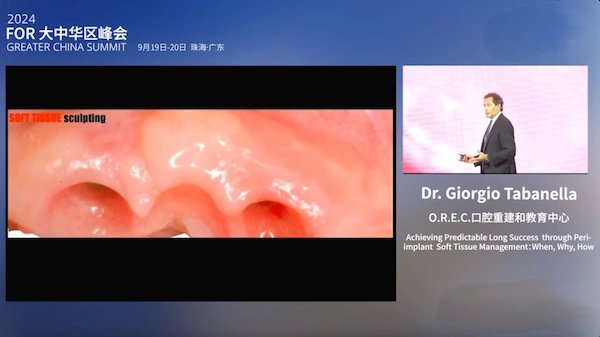

Achieving predictable long success through peri-implant soft tissue management: when, why and how – part 1
 Lecture
The management of peri-implant mucosa represents a fundamental determinant of long-term success in implant dentistry, particularly in the aesthetic zone. Beyond implant survival, the quality, thickness, and stability of the surrounding soft tissues play a critical role in achieving harmonious integration and preventing biological complications. Inadequate peri-implant mucosa—characterized by thin biotype, reduced keratinized tissue, and lack of buccal volume—is associated with an increased risk of recession, inflammation, and peri-implant disease.
Contemporary approaches emphasize the need for a biologically driven strategy focused on soft tissue augmentation and three-dimensional tissue stability. Techniques such as connective tissue grafts, vascularized pedicle flaps, and the use of collagen matrices have demonstrated effectiveness in enhancing mucosal thickness and improving resistance to mechanical and bacterial challenges. Special attention must be given to implant positioning and prosthetic design, as these factors directly influence soft tissue behaviour and long-term outcomes.
Minimally invasive surgical protocols aimed at preserving vascular supply and reducing patient morbidity are increasingly favoured. Furthermore, the reconstruction of gingival architecture, including buccal convexity and papillary support, is essential to achieve natural and biomimetic aesthetic results.
Effective peri-implant mucosa management shifts the focus from a purely implant-centered approach to a tissue-centered philosophy. Long-term success is therefore defined not only by osseointegration, but by the stability, health, and aesthetic integration of the peri-implant soft tissues.
This content is reserved for OREC Prime members.
Already have an OREC Prime account?
Not in OREC Prime Community yet?
Join a growing network of professionals and get free access to exclusive resources.
