

Management of peri-implant soft tissue deformities in the aesthetic zones
 Lecture
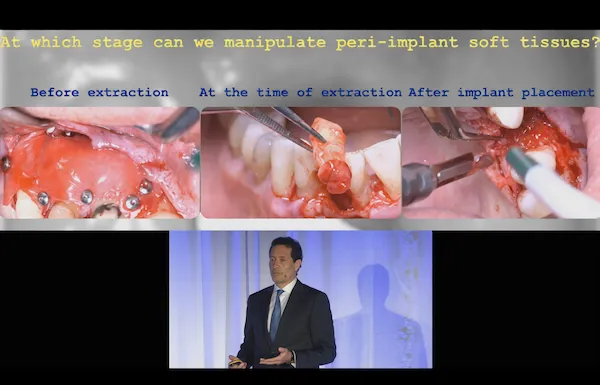
Peri-implant soft tissue deformities in the aesthetic zone represent a significant clinical and psychological challenge. These defects are frequently associated with inadequate tissue volume, improper implant positioning, or a history of periodontal disease. The resulting deficiency in buccal tissue thickness and gingival architecture negatively affects both esthetic outcomes and long-term peri-implant stability. A purely prosthetic approach is often insufficient to correct these conditions. Instead, successful treatment requires a biologically driven strategy aimed at three-dimensional soft tissue reconstruction. Increasing soft tissue thickness is crucial to mask underlying restorative components, improve tissue resilience, and reduce the risk of recession. Minimally invasive surgical approaches using vascularized flaps and collagen matrices can provide predictable enhancement of soft tissue volume. Particular attention should be directed toward restoring gingival convexity and papillary support in order to achieve a natural appearance. In many cases, a staged treatment approach is necessary to progressively improve tissue quality, contour, and stability. In the aesthetic zone, success should not be measured solely by implant survival, but by the ability to recreate harmonious, biomimetic peri-implant soft tissue architecture.
This content is reserved for OREC Prime members.
Already have an OREC Prime account?
Not in OREC Prime Community yet?
Join a growing network of professionals and get free access to exclusive resources.
